UniBEaM Optical Fibre Beam Profiler, 75 mm
Dual axis beam profiler for measuring horizontal and vertical beam intensity profiles (up to 75 mm beam).
UniBEaM75
What is UniBeam?
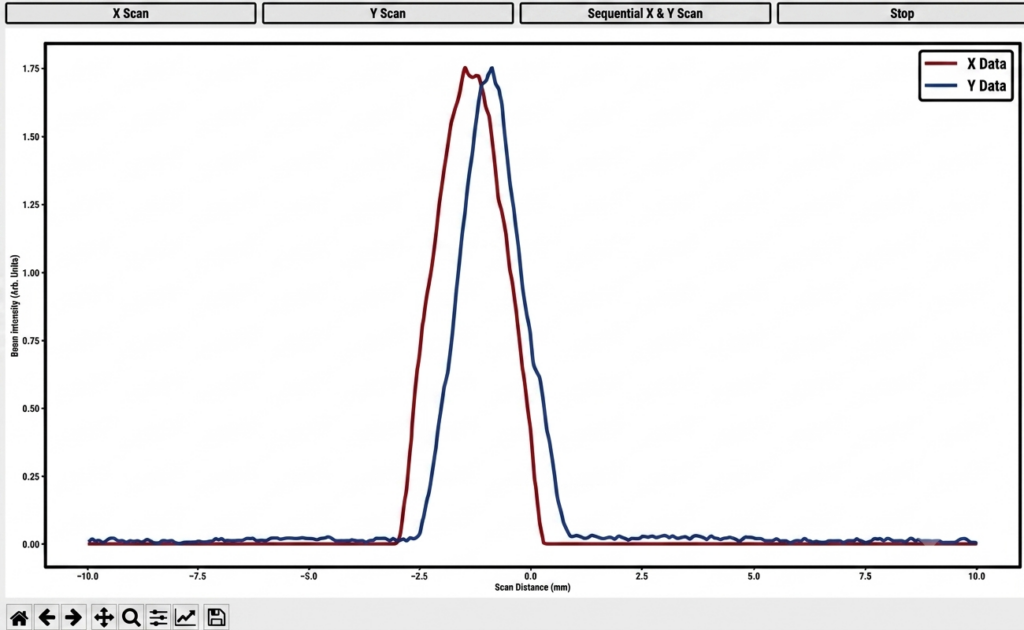
UniBEaM75 is the larger brother of UniBEaM25. UniBEaM is a particle beam profiling system – similar to a linear wire scanner except an optical sensor fiber is used instead of a metal wire. The probe scans horizontally and vertically through the distance range set by the operator and then plots the beam profiles. Unlike a helical wire scanner, the profiles are truly orthogonal, and the scanning range is controllable by the user.
D-Pace licensed UniBEaM from AEC-LHEP of the University of Bern.
How does UniBEaM work?
UniBEaM75 utilizes Ø600µm SiO2 sensing fibers, which scintillate as the fibers pass through the beam. The scintillation light is transmitted through the short sensor fiber into a multimode optical fiber, which transmits the light 15m or more with minimal attenuation and no electromagnetic susceptibility. The light is converted by a high-sensitivity photo sensor located in the UniBEaM controller and the beam profiles are ultimately displayed on a monitor.
What is included with the system?
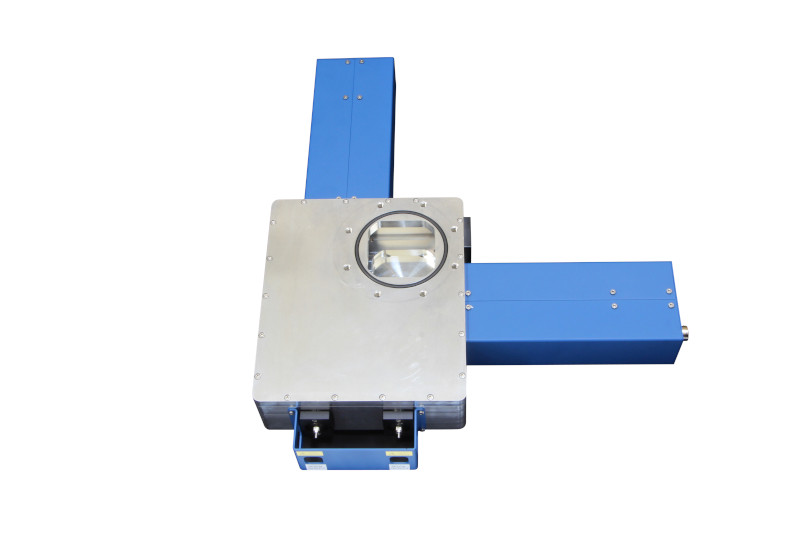
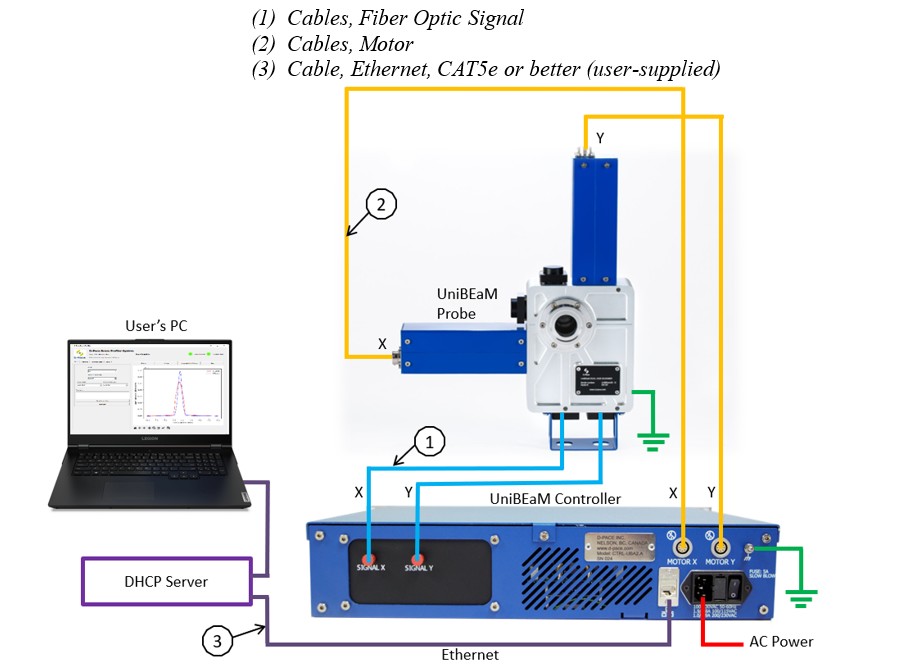
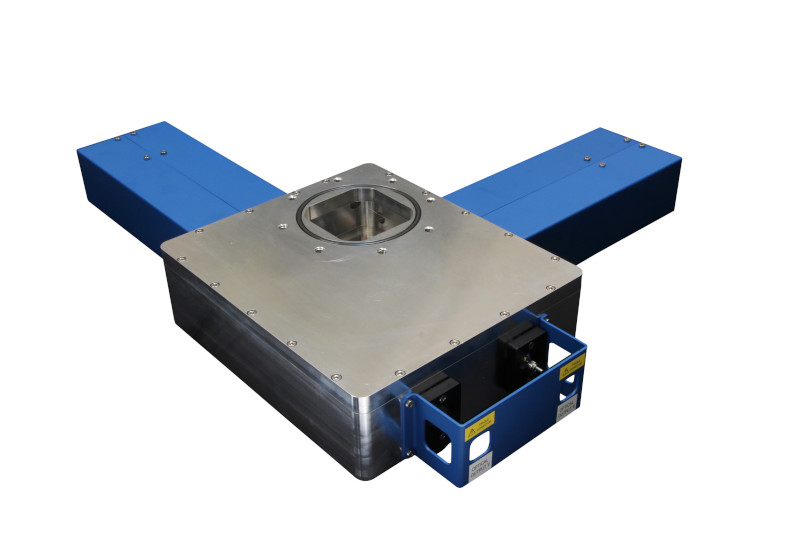
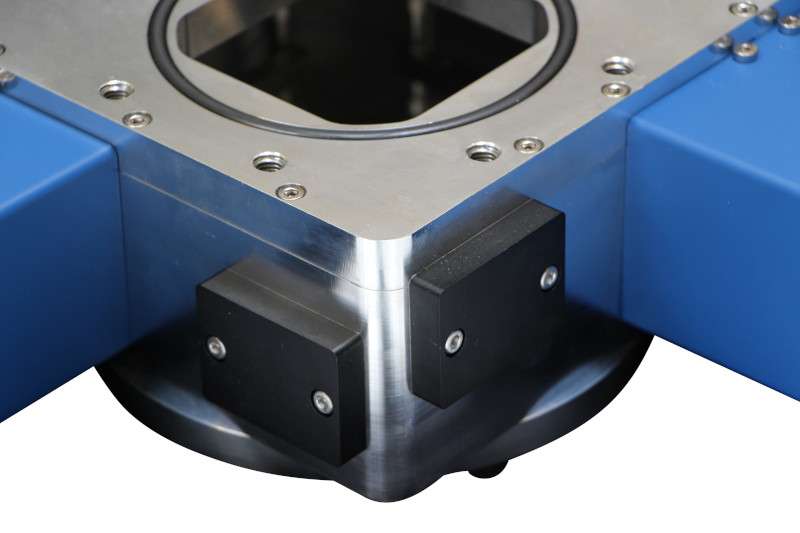
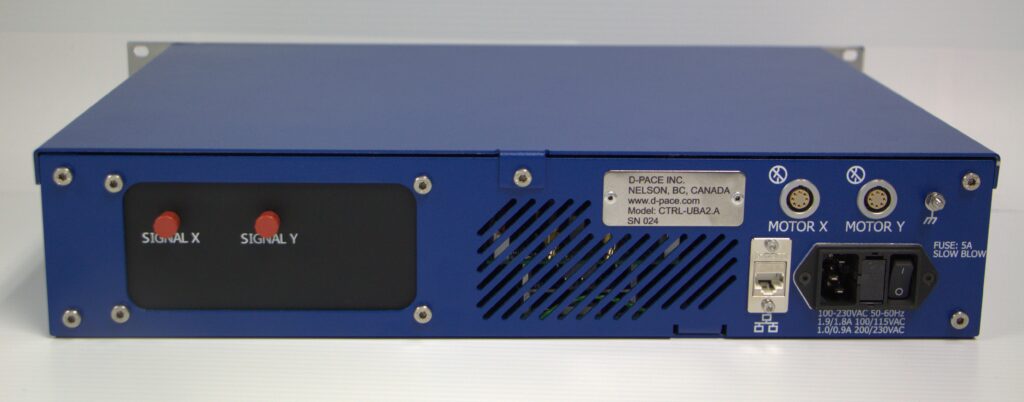
The UniBeaM75 probe is an inline device with an ISO100-F Flange and an insertion length of 82mm. The body of the probe is aluminum. The maximum measurable beam diameter is 75mm. Four cables connect the probe to the controller – two motor cables and two fiberoptic signal cables, which are all provided.
How do I communicate with UniBEaM?
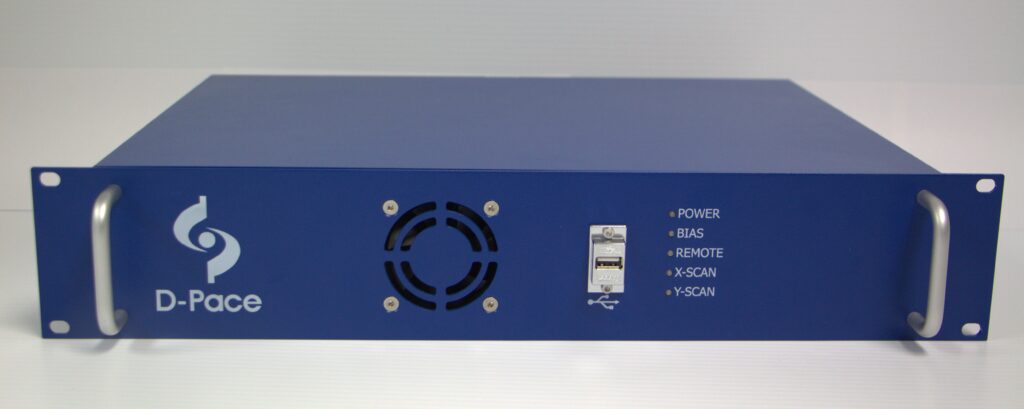
A windows-based user interface is provided, which can be installed on a remote PC to operate the profiler. However, the user can also communicate directly with the controller using the controller of their choice and TCP/IP text-based commands.
Why use UniBEaM instead of a standard wire scanner?
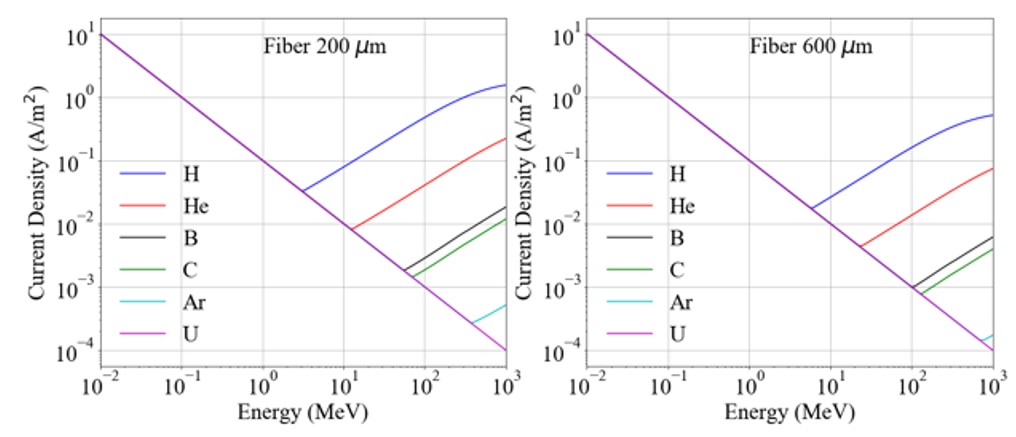
UniBEaM was originally developed by the University of Bern to measure 18 MeV protons with beam currents from nA to µA. Because most of the beam at such energies passes through the fiber, less power is absorbed by the fiber than a tungsten wire, allowing it to be used at higher beam currents. The maximum absorbed power density the fiber can be used at is 0.1 W/mm^2. The plot below illustrates that as the beam energy increases, the allowable current density also increases.
UniBEaM is also well-suited for low beam power, due to the large dynamic range of the fibers. Customers have used UniBEaM for electron and X-rays beams, neutral beams, as well as charged particle beams (protons etc.). UniBEaM scans beams in mutually exclusive axes, unlike helical wire scanners.
Previous customers include the Australian National University, the University of Michigan, the Federal Institute of Metrology (MATAS), Switzerland, and others.
Beam Parameters
| Max Beam Diameter | 75 mm |
|---|---|
| Particle Energy | > keV |
| Max Power Density | 10 W/cm^2 |
Probe
| Sensor Fibers | Doped Silica Ø600 µm |
|---|---|
| Position Resolution | 0.2 mm |
| Scan Speed | 26 mm/s |
| Probe Insertion Length | 82 mm |
| Flange Options | ISO 100-F |
| Probe Mass | 13 kg |
| Sensor Fiber Installation Port | KF16 |
Controller
| Controller Size | 2U 19" Rack Mount |
|---|---|
| Communications | TCP/IP text-based |
| Input Power | 100-240VAC 50/60 Hz |
| Cable & Fiber Lengths | 15 meters (custom available) |
| Data File Format | CSV with header |