Recreating Space on Earth: Advancing VLEO Research with the University of Stuttgart’s Institute of Space Systems
A. GEORGE Z. WATKINS ISV.RF-30

Challenge
As interest grows in satellite operations within Very Low Earth Orbit (VLEO), researchers face a critical challenge: understanding how atomic oxygen interacts with spacecraft surfaces. At VLEO altitudes, atomic oxygen is a primary contributor to atmospheric drag, material degradation, surface chemistry effects, and ultimately satellite lifetime and performance. To generate the experimental data needed to address these challenges, the High Enthalpy Flow Diagnostics Group (HEFDiG) – part of the Institute of Space Systems (IRS) at the University of Stuttgart in Germany – is developing a specialized facility capable of producing a directed beam of neutral atomic oxygen that accurately replicates the conditions satellites experience in orbit. A particularly difficult requirement of this project is achieving an atomic oxygen beam velocity of approximately 8 km/s, equivalent to orbital velocity. Accurately reproducing this velocity is crucial because the interaction between atomic oxygen and material surfaces depends on the energy of the oxygen particles. As an initial proof-of-concept experiment, the HEFDiG team needed to demonstrate that a negative oxygen ion beam could be generated, transported, and decelerated before conversion into a neutral atomic oxygen beam.
Generating the required beam presented a specific source challenge: conventional filament ion sources are not suitable for oxygen plasma. They therefore needed a viable negative oxygen ion source as well as access to sophisticated beamline infrastructure – capabilities that would otherwise require a significant upfront investment in time and resources.
Approach
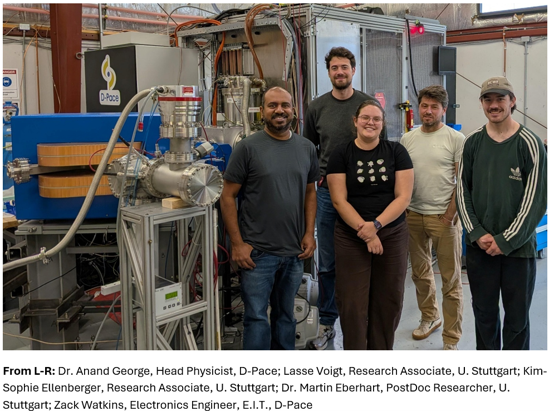
Rather than developing a dedicated test facility from the ground up for this proof of concept, the HEFDiG team leveraged D-Pace’s Ion Source Test Facility (ISTF) through our test stand rental services. D-Pace provided an external RF antenna ion source solution capable of producing the required oxygen plasma and negative oxygen ion beam. The HEFDiG research team then integrated its custom-designed negative ion decelerator directly into D-Pace’s existing operational beamline while utilizing D-Pace’s beam transport systems, diagnostics, technical expertise, and experimental infrastructure.
This approach enabled the researchers to focus on advancing their core technology rather than constructing and commissioning supporting infrastructure. By providing immediate access to a proven ion beam environment, D-Pace helped accelerate experimental validation, reduce technical risk, and shorten development timelines. The project demonstrates how D-Pace’s test facility services allow customers to rapidly evaluate new concepts, validate designs, and generate critical performance data before investing in permanent facilities or production systems.
Result
The proof-of-concept campaign successfully integrated HEFDiG’s negative ion decelerator into D-Pace’s existing beamline. Testing verified transport of negative oxygen ions through the decelerator, and the experimental results indicated successful negative ion deceleration. The results also suggest a possible accumulation of positive ions in the beamline downstream of the deceleration stage. This was unexpected and may indicate ionization of the background gas or stripping processes within the beamline. Further experiments and potential system modifications are therefore required to investigate this phenomenon.
The teams will evaluate the experimental data and use the findings to determine future beamline modifications. The work advances HEFDiG’s VLEO simulation capability and may ultimately support improved drag prediction models, development of low-drag spacecraft materials and coatings, material durability testing, and more accurate simulation of the atomic oxygen environment encountered by satellites operating in VLEO. More broadly, the project demonstrates how D-Pace’s test stand rental services give researchers on-demand access to proven ion source and beamline infrastructure, enabling them to move from concept to experimental results faster and with less upfront investment.