Texas A&M University Expands K150 Cyclotron Capabilities with D-Pace’s Dual-Polarity Ion Source
A. GEORGE ISV.F-90 ES-4
Challenge

Texas A&M University’s Cyclotron Institute wanted to expand the capabilities of its K150 cyclotron while replacing an aging H⁻ ion source. The existing source was designed primarily for negative hydrogen beam production and could not readily produce positive ion beams without significant mechanical modification to the extraction system. This limited operational flexibility and restricted the range of ion species available for research programs.
The Institute required a modern ion source capable of supporting both positive and negative ion beam operation while maintaining the beam quality, reliability, and stability needed for advanced nuclear physics and applied research. Researchers also wanted access to additional ion species, including hydrogen and helium beams, without the need for complex source reconfiguration.
In addition, the previous system lacked some of the operational flexibility needed to efficiently optimize source performance. Improving gas flow control, source diagnostics, and beam steering capability were important considerations to support future experimental programs and maximize cyclotron utilization.
Approach
D-Pace supplied its Positive/Negative Filament Ion Source, a direct-current volume cusp ion source licensed from TRIUMF and designed to produce both positive and negative light-ion beams from a common source platform. The source is capable of producing H⁻, D⁻, H⁺, D⁺, He⁺ and other light-ion species while enabling operators to switch between positive and negative extraction modes through external power supply and control changes rather than internal mechanical modifications.
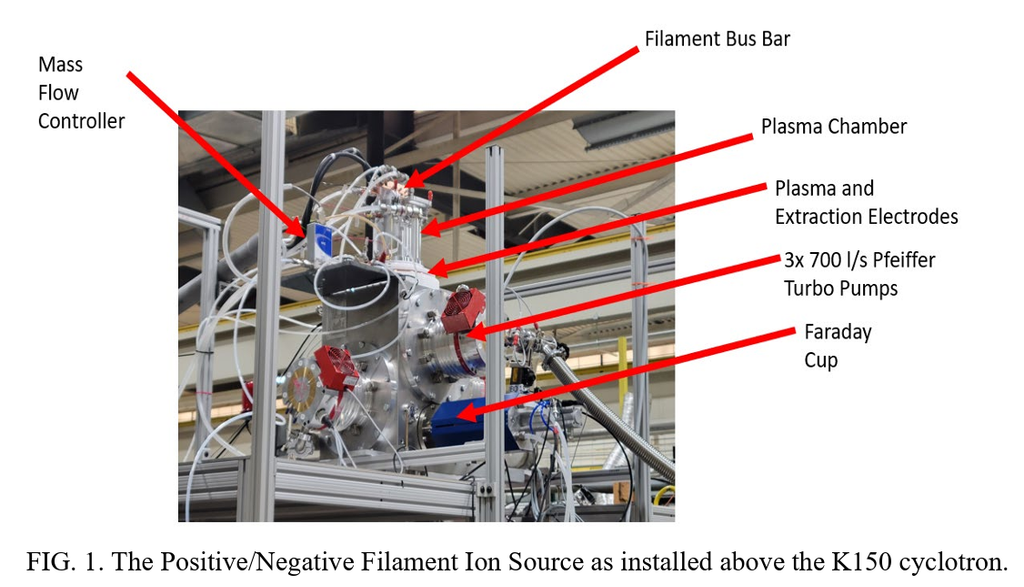
The ion source consists of a plasma chamber containing a tantalum filament-driven plasma and associated extraction electrodes, coupled to a diagnostic box that incorporates beam diagnostics, an X-Y steering magnet, and interfaces for vacuum pumping and additional instrumentation. This architecture provides operators with enhanced control over beam transport and source tuning.
As part of the overall ion source solution, D-Pace also supplied a comprehensive beam diagnostics package to support commissioning, optimization, and long-term operation of the system. This included a D-Pace Single Probe Emittance Scanner for rapid beam emittance characterization and a 1 kW Faraday Cup for high-power beam current measurements. Together, these diagnostic tools provide Texas A&M researchers with the ability to accurately measure beam quality, verify source performance, and efficiently tune the ion source and beamline for a wide range of operating conditions.
A key aspect of the solution was D-Pace’s development of a dual-polarity extraction system that enables stable positive-ion operation while preserving the source’s proven negative-ion performance. The design incorporates an electron suppression electrode and optimized extraction geometry to mitigate issues associated with back-streaming electrons and high-voltage operation during positive-ion extraction. D-Pace also worked closely with Texas A&M staff to update power supplies and electrical connections, enabling operation in both positive and negative ion modes while correcting polarity-related issues present in the previous configuration.
Result
The new D-Pace ion source successfully expanded the operational capabilities of the K150 cyclotron by providing a single platform capable of producing both positive and negative ion beams. Installation was completed with only minor alignment adjustments, allowing commissioning to proceed efficiently and minimizing disruption to facility operations.
During commissioning, Texas A&M successfully accelerated and extracted hydrogen beams with intensities up to 20 μA and helium beams with intensities up to 9 μA. These results demonstrated the source’s ability to reliably deliver multiple ion species for accelerator operations and experimental use.
Beyond the initial commissioning results, the new source provides a significant increase in operational flexibility. Researchers can now switch between positive and negative ion operation without modifying the extraction hardware, reducing downtime and simplifying source configuration. The integrated diagnostics, steering capability, and improved gas-flow control also provide greater control over beam tuning and optimization.
The D-Pace ion source gives Texas A&M’s Cyclotron Institute a versatile, future-ready injector platform that delivers stable, high-current proton and deuteron beams for producing exotic radioactive nuclei used in reaccelerated radioactive beam experiments, radiation-effects testing of electronic systems at energies from 3 to 50 MeV, and isotope production research, including At-211 generation for targeted alpha therapy applications. By combining multi-species capability, reliable operation, and simplified switching between positive and negative ion modes in a single source, the upgraded system expands the scientific potential of the K150 cyclotron across nuclear physics, accelerator science, materials science, and applied research programs.